


When beginners learn Object-Oriented Programming, they usually focus on:
Classes
Objects
Methods
Inheritance
But in real software systems, the most important question is often:
How do objects related to each other?
Consider an E-Commerce system.
We have:
Customer
Order
Product
Payment
The classes themselves are simple.
The challenge is understanding:
Who knows whom?
Who can access whom?
Who owns whom?
Who communicates with whom?
How many relationships exist?
Most real-world design mistakes occur not because a class is poor written, but because relationships between classes are poorly modeled.
Association is the first and most fundamental relationship in UML.
Everything else:
Aggregation
Composition
Dependency
can be viewed as specialized forms of association.
What Is an Association?
Definition:
Association represents a structural relationship where one object knows about another object.
Or
It is an connection between two classes that allows one object to use or communicate with another.
The key phrase is:
Knows AboutAssociation does NOT imply:
Ownership
Lifecycle Control
Creation Responsibility
Containment
It simply means:
One object can communicate with another.It is the most general (or broadest) relationship between object in OOAD.
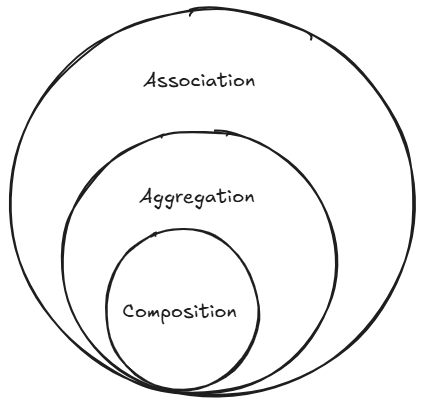
Why is Association the broader term?
An association simply means:
Two objects are related in some way.

It says nothing about:
Ownership ❌
Lifetime ❌
Responsibility ❌
Containment ❌

It only says:
"These two objects are connected."
Real-World Analogy
Imagine:
Doctor ←→ PatientA doctor knows about patients.
A patient knows about doctors.
Neither owns the other.
Neither controls the other's lifecycle.
This is a classic association.
Characteristics of Association
Association reflects a “has-a” or “uses-a” relationship.
Association has several important characteristics.
1 Objects Are Independent
Each object has it own lifecycle. Objects are lossely coupled and can exist independently of one another. The association can be unidirectional or bidirectional, and can follow different multiplicity patterns (1-to-1, 1-to-many, etc.).
Example:
Teacher -------- StudentA teacher exists even if no students are assigned.
A student exists even if no teacher is currently assigned.
Neither depends on the other's existence.
2 Objects Can Communicate
Association enables collaboration.
For example:
Customer -------- OrderA customer can place orders.
An order knows which customer placed it.
3 Association Represents Business Relationships
Association models relationships that naturally exist in the business.
Examples:
Doctor -------- Patient

Author -------- Book

Employee -------- Department

Customer -------- Bank Account
These relationships exist even without software.
First UML Association
Association is represented using a simple solid line.
Example:
Customer places OrderDiagram:
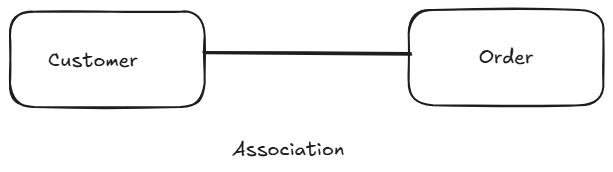
+------------+      +------------+
| Customer   |------|   Order    |
+------------+      +------------+
The line indicates that the two concepts are related.
Nothing more.
Interpretation:
Customer and Order are related.Association in C++
Suppose:
class Order
{
};

class Customer
{
private:
    vector<Order*> orders;
};
Customer knows Orders
Association exists.
Notice:
Order can exist independently.Customer can exist independently.Association does not imply ownership.
Mental Model
Whenever you hear:
Uses
Knows
Works With
References
Interacts With
Think:
AssociationDirection of Association
Associations may be:
1 Unidirectional
Only one object knows about the other.
Customer -------------> OrderThe customer knows its orders.
The order does not know its customer.
C++ Example:
class Order
{
};

class Customer
{
private:
    std::vector<Order*> orders;
};
Only Customer stores references to Order.
2 Bidirectional
Both objects know each other.
Customer <------------> OrderCustomer knows its orders.
Order knows its customer.
C++ Example:
class Customer;

class Order
{
private:
    Customer* customer;
};

class Customer
{
private:
    std::vector<Order*> orders;
};
Both classes maintain references.
Association vs Ownership
A common misunderstanding.
Many developers think:
Customer → Ordermeans Customer owns Order.
Not necessarily.
Association only says:
There is a relationship.Ownership is introduced later through:
Aggregation
Composition
Multiplicity
Association alone is incomplete.
We must answer:
How many obejcts participate?This is called multiplicity.
Example:
One Customer Many OrdersDiagram:
Customer 1 -------- * OrderMeaning:
One customer can have many orders.Multiplicity Notation (Cardinality)
Association also tells us how many objects participate in the relationship.
This is called multiplicity.
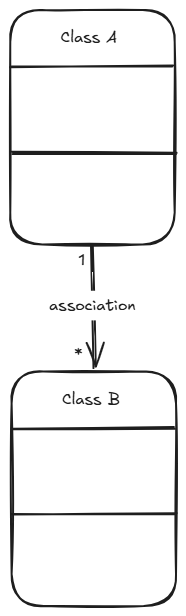
One-to-One (1 : 1)
Example:
Person -------- PassportEach passport belongs to one person.
Each person has one passport.
1 -------- 1One-to-Many (1 : *)
Example:
Department -------- EmployeeOne department has many employees.
Each employee belongs to one department.
1 -------- *Many-to-One (* : 1)
Simply the reverse.
Employee -------- DepartmentMany empoyees work in one department.
Many-to-Many (* : *)
Example:
Student -------- CourseOne student studies many courses.
One course contains many students.
* -------- *Exactly One
1Example:
Order 1 ---- 1 PaymentOne payment per order.
Zero or One
0..1Example:
Order ---- 0..1 CouponCoupon optional.
Many
*Meaning:
UnlimitedExample:
Customer 1 ---- * OrderOne or More
1..*Example:
Team 1 ---- 1..* PlayerRange
2..5Example:
Car 1 ---- 4..5 TireFour or five tires.
Reading Multiplicity Correctly
Students often read multiplicity backward.
Example:
Customer 1 -------- * OrderCorrect reading:
One Customer can have many Orders.NOT:
One Order has many Customers.Rule:
Look at the multiplicity near the opposite class.
Example:
Teacher 1 ------- * StudentInterpretation:
One teacher teaches many students.One-to-One Association
Example:
Person 1 -------- 1 PassportMeaning:
Each person has one passport.
Each passport belongs to one person.
C++ Example:
class Passport
{
};

class Person
{
private:
    Passport* passport;
};
One-to-Many Association
Example:
Department 1 ------ * EmployeeMeaning:
One department contains many employees.C++ Example:
class Employee
{
};

class Department
{
private:
    vector<Employee*> employees;
};
Many-to-Many Association
Example:
Student * ------- * CourseMeaning:
Student can enroll in manay courses.
Course can contain many students.
C++ Example:
class Course;

class Student
{
private:
    vector<Course*> courses;
};

class Course
{
private:
    vector<Student*> students;
};
Navigability
Association may be directional.
Question:
Who knows whom?Unidirectional Association
Example:
Customer ------> OrderMeaning:
Customer knows Order.

Order does NOT know Customer.
C++ Example:
class Order
{
};

class Customer
{
private:
    vector<Order*> orders;
};
Only one side has a reference.
Bidirectional Association
Example:
Customer <------> OrderMeaning:
Customer knows Order.

Order knows Customer.
C++ Example:
class Customer;

class Order
{
private:
    Customer* customer;
};

class Customer
{
private:
    vector<Order*> orders;
};
Both objects know each other.
When to Use Bidirectional Associations
Many beginners create bidirectional relationships everywhere.
Bad idea.
Example:
Customer ↔ Order
might be useful

But:
Product ↔ Every Other Class
create chaos.
Rule:
Use bidirectional association only when both directions are genuinely needed.
Self Association
A class can associate with itself.
Example:
Employee manages EmployeeDiagram:
Employee
    ^
    |
    |
Employee
Meaning:
Manager is also an Employee.C++ Example:
class Employee
{
private:
    Employee* manager;
};
Common Uses:
Organization Hierarchies

Folder Structures

Comment Threads

Category Trees
How to Decide Which Relationship is this?
A senior architect doesn't look at two classes and say:
“Hmm… I think this should be composition.”
Instead, they ask questions about the business semantics.
Step 1: Are these concepts related at all?
Ask:
Do these two concepts interact in the business?
If the answer is No, then there is no relationship.
Example:
Engine StudentNo business relationship.
If Yes, then start with:
AssociationBecause every meaningful relationship starts as an association.
Step 2: Is it just a connection?
Ask:
Do these objects simply know about each other?
Example:
Doctor --------- PatientDoctor treats Patient.
Patient visits Doctor.
Neither ows the other.
Both exist independently.
✅ AssociationStep 3: Is it a Whole-Part relationship?
Now ask:
Is one concept a whole and the other a part?
Example:
Car
Wheel
A wheel is part of a car.
Now we move beyond a simple association.
We ask another question.
Step 4: Can the part exist independently?
If YES
Department
Employee
Employee can move to another department.
The department closes, Employees still exist.
✅ AggregationIf No
House
Room
Conceptually, a room doesn't exist without a house.
Destroy the house, the rooms disappear.
✅ CompositionThe Complete Decision Tree
Are the two concepts related?
            │
      ┌─────┴─────┐
      │           │
     No          Yes
      │           │
 No Relationship  ▼
             Association
                   │
                   ▼
      Is it a Whole-Part relationship?
                   │
          ┌────────┴────────┐
          │                 │
         No                Yes
          │                 │
    Association             ▼
             	Can the part exist independently?
        	           │
        	  ┌────────┴────────┐
       	      │                 │
         	 Yes               No
       	      │                 │
         Aggregation      Composition

Join the discussion
Sign in with your account to post comments, reply to others, and participate in the conversation.
Login to Comment