



The Historical Evolution of API Gateways
The Monolith Era (Pre-2005)
A monolithic application was a single, tightly coupled software system where:
- UI
- Business logic
- Data access
- Security
- Integrations
… all lived inside one codebase, deployed as one unit, and scaled as one process.
Typical characteristics:
- One WAR file (Java)
- One EXE (Windows)
- One deployment artifact
- One database
- One operations team
There was no concept of independently deployable services.
If you changed one line of code:
The entire system had to be rebuilt and redeployed.
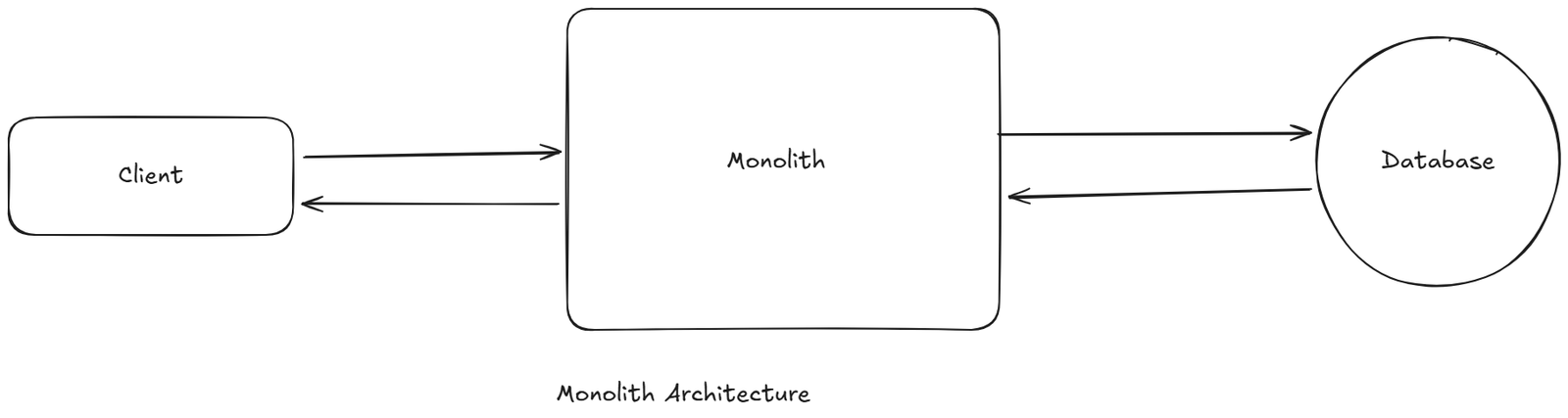
The monolith itself was the gateway:
- It handled authentication
- It handled routing (internally via function calls)
- It handled validation
- It handled business logic
- It handled database access
Microservices (Around 2010)
The original definition of microservices was not about buzzwords. It meant:
- Small, independently deployable services
- Each service:
- Owned its own logic
- Often owned its own database
- Had an independent lifecycle
- Services communicated over:
- HTTP/REST
- Message queues
In the monolith era:
Client -> One ApplicationIn microservices:
Client -> ??? -> 30 services -> 60 services -> 100 servicesWithout an API Gateway, early microservices systems made clients directly call:
- Auth Service
- User Service
- Order Service
- Payment Service
- Inventory Service
- Notification Service
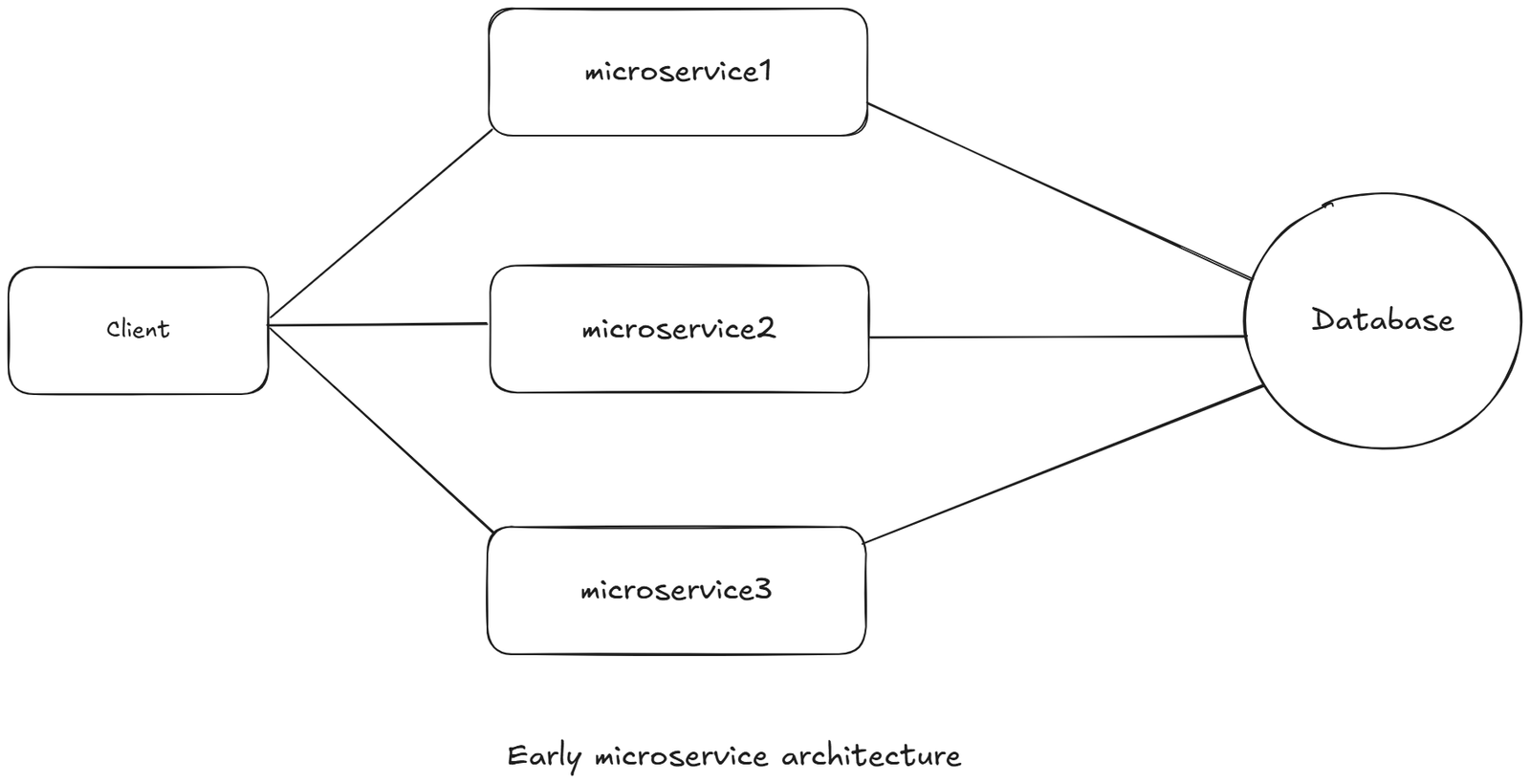
This caused immediate disasters:
- Clients had to understand internal service topology
- Client had to know the URL of every single microservices and when to call each of them respectively.
- If there is an master services like microservice1, which would redirect the request to other services accordingly.
- Every client implemented its own retry logic
- Auth logic duplicated everywhere
- No central rate limiting
- Security was inconsistent
- Network latency exploded
Birth of API Gateway (2014)
Netflix is widely credited with formalizing the API Gateway pattern.
By 2010:
- Backends had:
- 50-200+ microservices
- Independent deployments
- Independent failures
- Clients had:
- Web apps
- Mobile apps
- Partner systems
- Public developers
But there was no single entry point anymore.
Clients were directly calling:
- User Service
- Payment Service
- Order Service
- Inventory Service
This caused:
- Tight coupling between clients and internal services
- Zero centralized security
- Zero rate limiting
- Zero API version governance
- Extreme latency explosion
- Massive security exposure
This chaos forced the creation of the First-Gen API Gateway.
It focused on three core capabilities only:
- Routing
- Authentication
- Aggregation
They were not yet full API platforms.
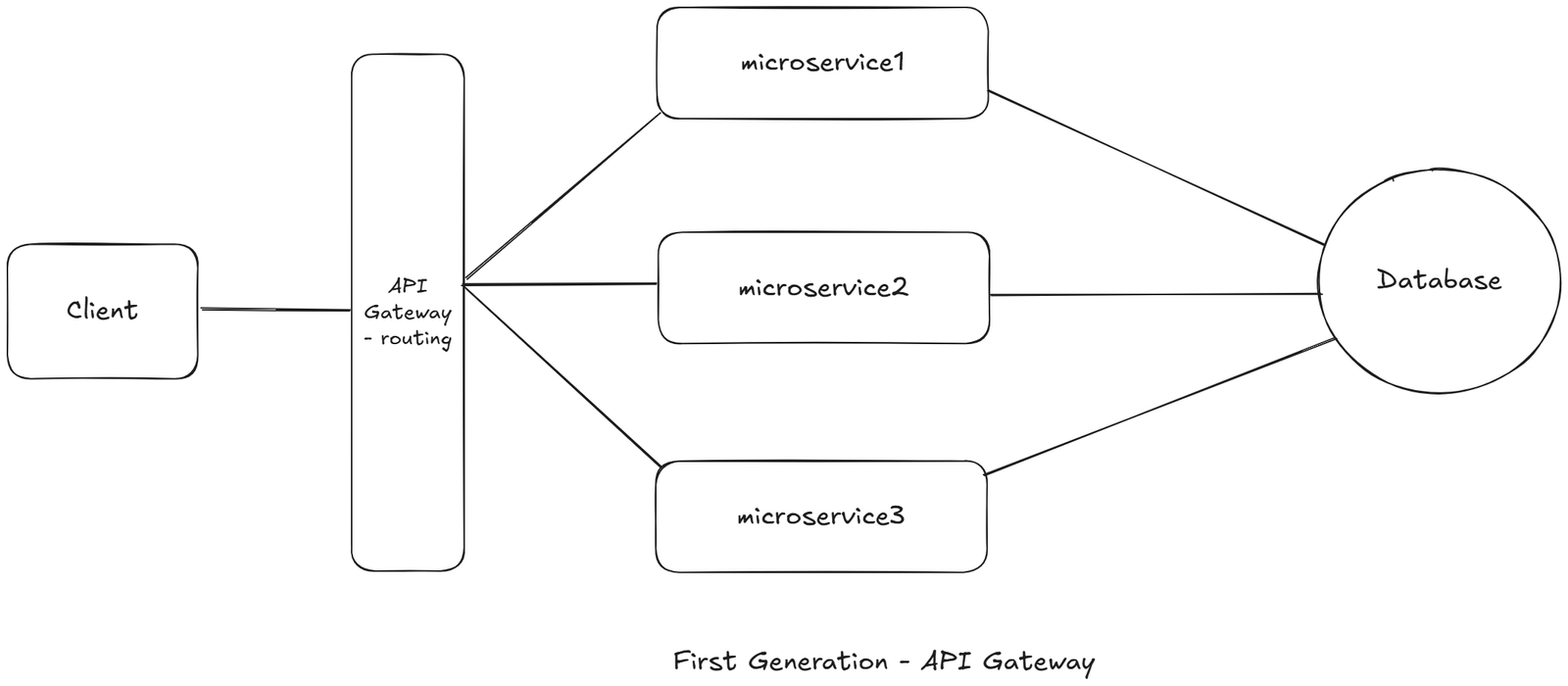
This solved the routing problem.
Second Generation API Gateway
Every microservice now contained the same boilerplate code:
- Authentication
- Authorization
- Rate limiting
- Logging
- Metrics
- CORS
- Request validation
- Header propagation
- Retries and timeouts
- Circuit breaking
This duplicated logic created operational entropy.
Imagine you now have 50 microservices
- User Service
- Order Service
- Payment Service
- Inventory Service
- Notification Service
- …
Now think about this question:
Does every one of these services need to do security, logging, rate limiting, validation, etc.?
Sadly, in early microservices YES – they all did it themselves
So every service had this repeated code:
- JWT token validation
- Role checks (admin/user)
- Logging requests
- Sending metrics
- Checking bad input
- Handling retries
This means:
- Same code written 50 times
- Security bugs 50 times
- Config updates 50 deployments
This is what we call repeatable / cross-cutting code.
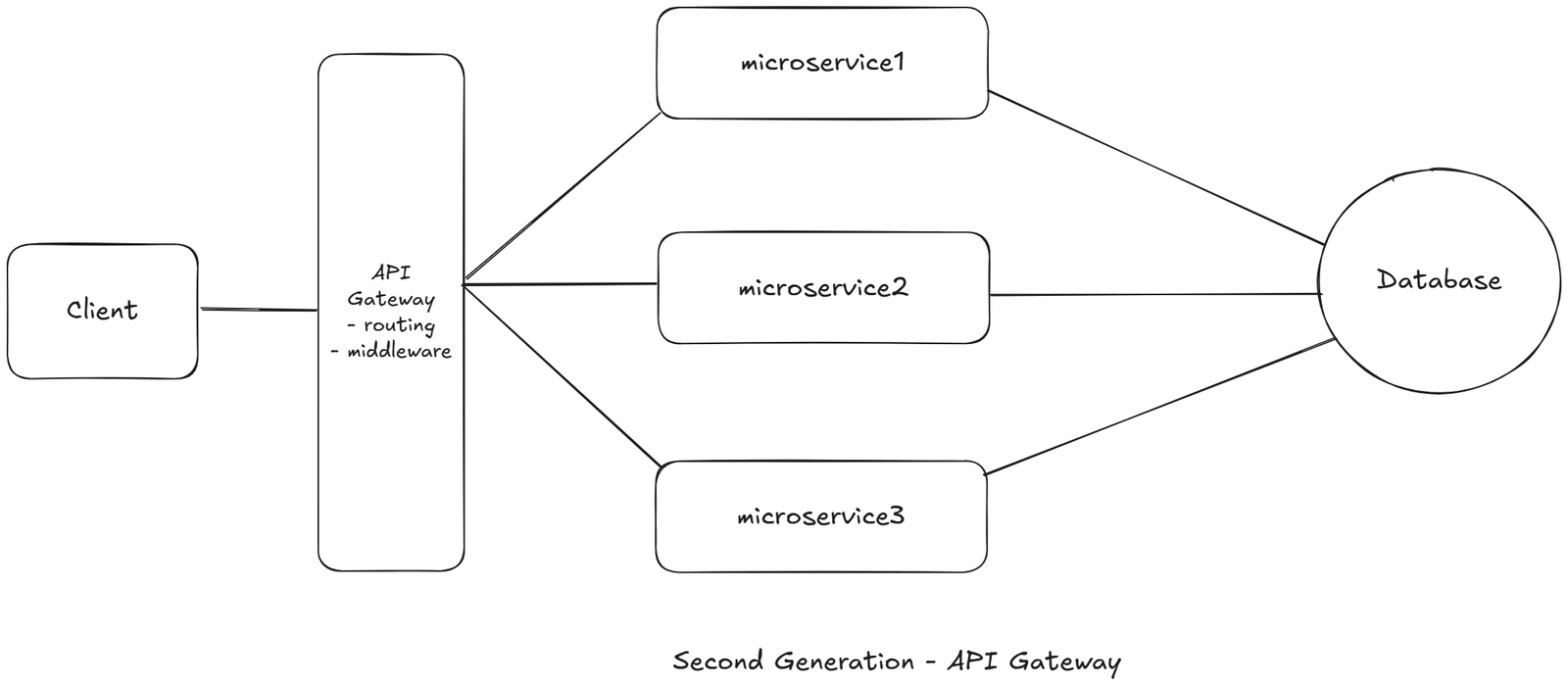
Because Earlier API Gateway (only did) this:
- Route request -> correct service
That's it.
But Next-Gen API Gateway became a “heavy middleware layer” that said:
“All common logic will run ONCE at the gateway – not inside every service”
So the API Gateway started doing this for ALL services:
- Authentication
- Authorization
- Rate limiting
- Request validation
- Logging
- Metrics
- Header handling
- CORS
- Throttling
- Basic retires
Now microservices only do:
- Business logic
- Database work
- Domain rules
Nothing else.
What is an API Gateway?
An API Gateway serves as a single entry point for all client requests, managing and routing them to appropriate backend services.
A programmable reverse proxy that sits between clients and backend services and centralizes all cross-cutting concerns.
In simple words:
It is the single front door of your entire backend system.
API Gateway Process
When a request enters an API Gateway, it passed through a well-defined pipeline. Each stage has a specific responsibility, and together they protect your backend, enforce policy, and ensure only high-quality traffic reaches your services.
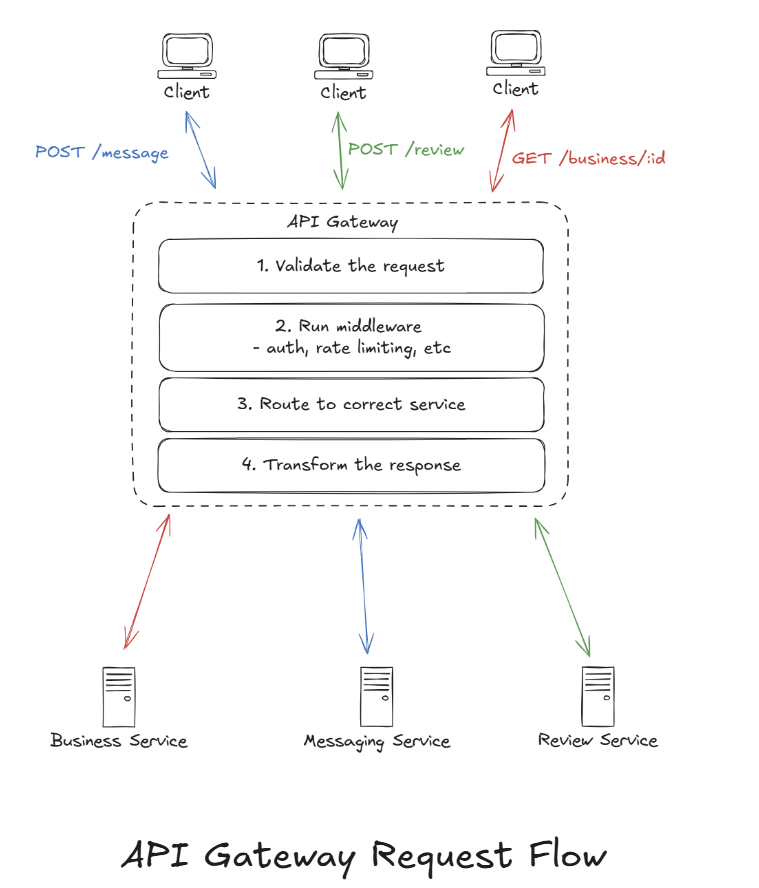
1 Request Validation (First Line of Defense)
Before doing anything else, the API Gateway verifies that the incoming request is structurally correct and complete.
This includes:
- Checking if the URL/path is valid
- Verifying that mandatory headers are present (e.g, Authorization, API key)
- Ensuring the request body matches the expected schema (JSON/XML format)
- Validating request size limits
- Checking content-type correctness
Why this matters:
Early validation prevents garbage traffic from reaching the backend.
For example:
- A mobile apps sends malformed JSON
- A client forgets to include an API key
- A bot sends a 50MB payload to a 5KB endpoint
There is no business value in forwarding these requests. The gateway immediately rejects them with a clear 4xx errror and saves:
- Compute
- Network cost
- Backend thread pools
- Database load
This step alone significantly improves overall system stability.
2 Middleware Layer (Cross-Cutting Infrastructure Logic)
After validation, the request passed through the middleware pipeline. This is where all cross-cutting, reusable logic is applied.
Typical middleware responsibilities include:
- Authentication (JWT, OAuth, API keys)
- Rate limiting & throttling
- IP whitelisting/blacklisting
- SSL/TLS termination
- CORS handling
- Request and response logging
- Request compression
- Timeout handling
- API versioning
- Request size enforcement
- Traffic shaping
3 Routing (Where Does This Request Go?0
Once the request is authenticated and allowed, the gateway needs to decide which backend service should handle it.
Routing decisions are based on:
- URL path (
/users/* - HTTP method (
GET,POST) - Request headers
- Query parameters
- API version (
/v1,/v2)
A conceptual routing table looks like this:
routes:
  - path: /users/*
    service: user-service
    port: 8080
  - path: /orders/*
    service: order-service
    port: 8081
  - path: /payments/*
    service: payment-service
    port: 8082
The gateway performs a fast lookup in its routing table and forwards the request to the correct backend service.
Clients never need to know:
- Where services are deployed
- How many instances exist
- What ports they run on
That complexity is fully abstracted by the gateway.
4 Backend Communication & Protocol Translation
Once routing is resolved, the API Gateway forwards the request to the target service.
Most commonly:
Client -> HTTP/JSON
Gateway -> HTTP/JSON -> Backend
But sometimes:
Client -> HTTP/JSON
Gateway -> gRPC -> Backend
In such cases, the gateway performs protocol translation. It converts:
- REST to gRPC
- JSON to Protobug
- External API formats into internal service formats
This is powerful because:
- Clients get a simple, universal API
- Backend teams are free to choose the most efficient internal protocol.
This pattern is especially common in:
- High-performance systems
- Internal microservice communication
- Streaming-based architectures.
5 Response Transformation (Client-Friendly Output)
Once the backend responds, the API Gateway may transform the response before returning it to the client.
This can include:
- Formatting changes (gRPC -> JSON)
- Removing internal-only fields
- Renaming response attributes
- Aggregating multiple service responses
- Applying compression (gzip, brotli)
- Enforcing consistent API shape
Example conceptually:
- Client requests user profile over HTTP
- Gateway converts request to internal gRPC call
- Backend returns Protobuf
- Gateway converts result back to JSON and sends it to the client
This allows:
- Clean external APIs
- Flexible internal service evolution
- Backward compatibility
6 Caching (Performance Accelerator)
Before returning the response, the gateway may cache it if the data is non-user-specific and frequently accessed.
Common caching strategies:
- Full response caching (entire API response)
- Partial caching (specific response fields)
- TTL-based expiration
- Event-driven invalidation
Cache storage can be:
- In-memory (for ultra-fast response)
- Distributed cache like Redis
- CDN-backed edge caching
Caching is ideal for:
- Public catalogs
- Product lists
- Configuration data
- Static metadata
- Feature flags
Bad candidates for caching:
- User-specific data
- Financial transactions
- Real-time state
Used correctly, caching:
- Reduces backend load
- Improves latency
- Lowers infrastructure cost

Join the discussion
Sign in with your account to post comments, reply to others, and participate in the conversation.
Login to Comment