



Imagine you're about to undergo surgery.
Your doctor says:
"This procedure has a 90% survival rate."
You feel reassured.
Now imagine another doctor describing the exact same procedure.
They say:
"This procedure has a 10% mortality rate."
Suddenly, it feels much riskier.
Here's the surprising part.
Both statements describe the exact same reality.
Nothing changed except the wording.
Yet your feelings changed instantly.
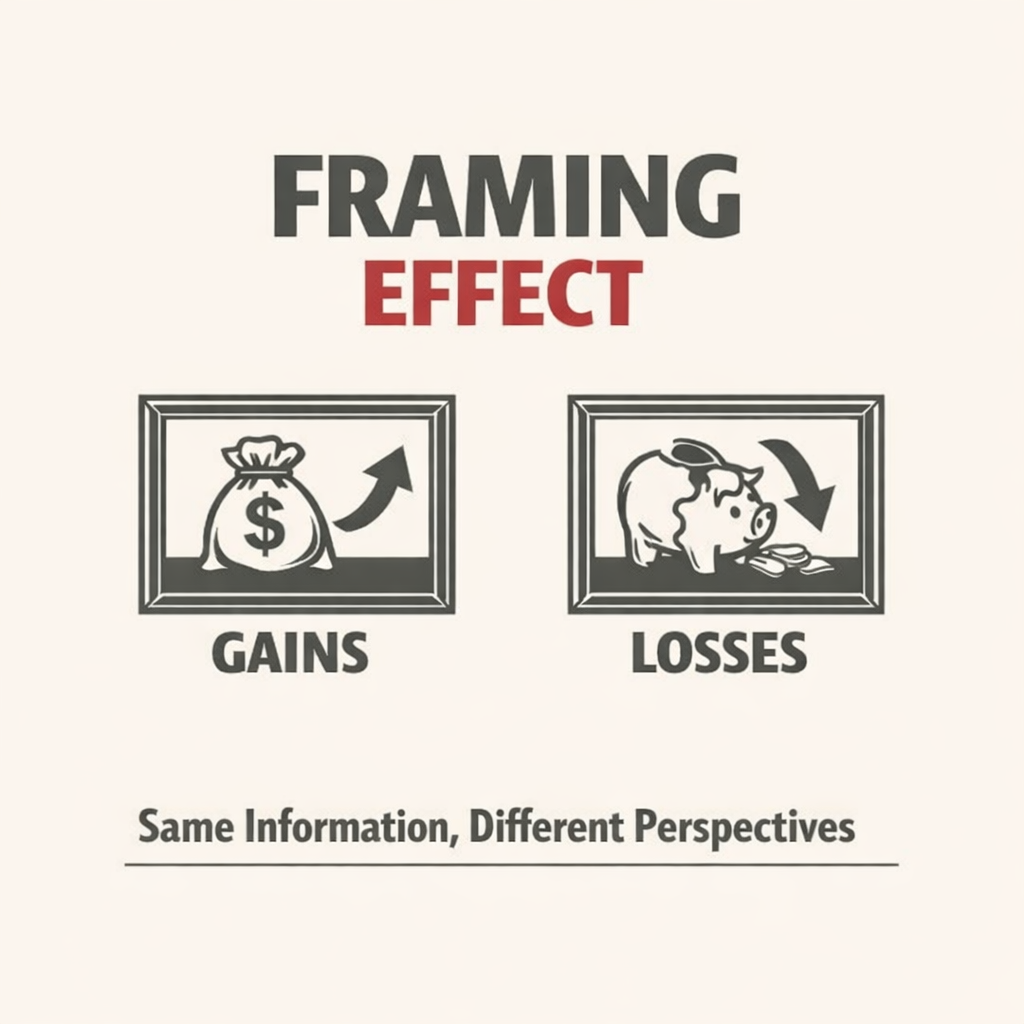
Welcome to the Framing Effect—a psychological bias where the way information is presented influences the decisions we make.
What Is the Framing Effect?
The Framing Effect is our tendency to make different decisions based on how the same information is presented, rather than on the information itself.
In simple terms:
The frame changes the decision—even when the facts stay the same.
Our brains don't respond only to facts.
They also respond to context, wording, and emotion.
Why Does Our Brain Do This?
Our brains are constantly trying to simplify complex decisions.
Rather than analyzing every detail objectively, we often react to the emotional meaning of words.
Positive frames make opportunities seem more attractive.
Negative frames make the same opportunities feel riskier.
The information hasn't changed.
Our perception has.
The Framing Effect Is Everywhere
Once you recognize it, you'll notice it everywhere.
Shopping
A product is advertised as:
"Save 20% today!"Instead of:
"Pay 80% of the original price."The numbers are identical.
The first message simply feels more rewarding.
Health
A medicine is described as:
"95% effective."Rather than:
"It doesn't work for 5% of patients."Most people respond more positively to the first description.
Finance
An investment is introduced as:
"It has delivered positive returns in 8 out of the last 10 years."Instead of:
"It lost money in 2 of the last 10 years."Both statements are true.
But they create very different impressions.
Everyday Life
Imagine your manager says:
"You completed 90% of the project."Now imagine they say:
"You still have 10% left."The progress is identical.
The motivation you feel probably isn't.
How Businesses Use the Framing Effect
Businesses rely on framing every day.
Restaurants describe dishes with carefully chosen words to make them sound more appealing.
Retailers advertise discounts instead of final prices.
Streaming services emphasize what you'll gain by subscribing rather than what you'll spend.
Even product packaging uses framing.
Labels like:
"99% fat-free"
"Made with real fruit"
"No added sugar"
highlight positive aspects while leaving other information in the background.
The product hasn't changed.
The presentation has.
When the Framing Effect Helps
Framing isn't always manipulation.
It can motivate positive behavior.
Doctors may frame treatment outcomes in encouraging ways to reduce unnecessary fear.
Teachers can frame feedback around progress instead of mistakes.
Managers can highlight achievements while still discussing areas for improvement.
The way we communicate often influences how people respond.
When It Becomes a Problem
The Framing Effect becomes harmful when wording influences us more than facts.
It can cause us to:
- Buy products we don't need.
- Make emotional financial decisions.
- Misjudge risks.
- Be influenced by advertising instead of evidence.
- Choose based on presentation rather than reality.
When the frame matters more than the facts, our judgment becomes biased.
How to Reduce the Framing Effect
The next time you're making an important decision, ask yourself:
- Would I make the same choice if this information were presented differently?
- What are the actual numbers behind the message?
- Is this statement emphasizing gains while hiding losses?
- Am I reacting to the facts—or to the wording?
These questions help separate emotion from information.
Final Thoughts
Words matter.
Not because they change reality.
But because they change how we perceive reality.
The Framing Effect reminds us that two people can present the same facts and leave us with completely different feelings.
The facts may be identical.
The decision may not be.
The next time a headline, advertisement, or conversation immediately convinces you of something, pause for a moment.
Ask yourself:
Has the reality changed... or has it simply been framed differently?






Join the discussion
Sign in with your account to post comments, reply to others, and participate in the conversation.
Login to Comment