


Imagine you're walking down the street.
You find a $1,000 note lying on the ground.
You'd probably feel happy.
Now imagine a different scenario.
You open your wallet and realize you've lost ₹1,000.
The amount is exactly the same.
Yet the feeling is completely different.
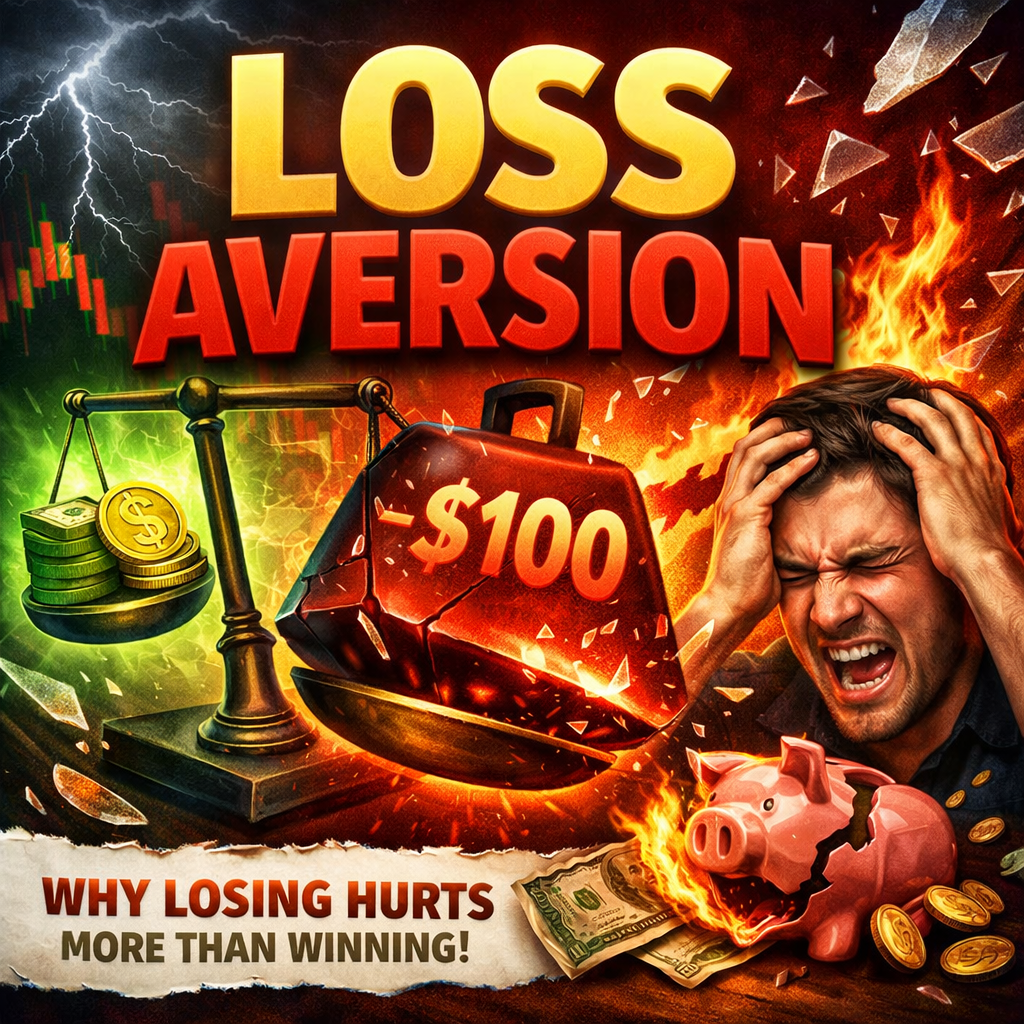
For most people, the pain of losing $1,000 is far greater than the joy of finding $1,000.
Why?
Because our brains aren't wired to treat gains and losses equally.
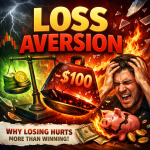
Welcome to Loss Aversion—one of the most powerful psychological biases influencing the decisions we make every day.
Table of contents [Show]
What Is Loss Aversion?
Loss aversion is the tendency to experience the pain of losing something more intensely than the pleasure of gaining something of equal value.
In simple terms:
Losses hurt more than equivalent gains feel good.
Psychological research suggests that, for many people, the emotional impact of a loss is roughly twice as powerful as the pleasure of an equivalent gain.
This doesn't mean everyone reacts the same way, but it helps explain why losses often carry so much emotional weight.
Why Does Our Brain Do This?
From an evolutionary perspective, avoiding danger was often more important than seeking additional rewards.
Losing food, shelter, or safety could threaten survival.
Finding a little more food was beneficial.
Losing the food you already had could be devastating.
Over thousands of years, our brains became highly sensitive to potential losses.
That instinct still influences our decisions today—even when the stakes are far less dramatic.
Loss Aversion Is Everywhere
Once you recognize it, you'll see it all around you.
Investing
An investor watches a stock lose 40% of its value.
Instead of selling and moving on, they hold onto it, hoping it will recover.
Selling would mean accepting the loss.
Keeping it feels emotionally easier.
Shopping
A customer sees:
"Last day to save 40%!"
The fear of missing the discount feels stronger than the excitement of buying the product.
The potential loss drives the purchase.
At Work
An employee avoids asking for a promotion because rejection would feel worse than the potential satisfaction of getting a raise.
The fear of loss outweighs the possibility of gain.
Relationships
Sometimes people remain in unhappy relationships because losing the familiarity, shared memories, or routine feels more painful than the possibility of finding a healthier future.
How Business Use Loss Aversion
Businesses understand this principle remarkably well.
Free trials.
Money-back guarantees.
Limited-time offers.
"Only 3 items left."
These strategies make us feel that we might lose something valuable if we don't act.
Many subscription services also make cancellation feel like giving something up.
Instead of thinking,
"Should I subscribe?"
we begin thinking,
"Do I really want to lose access?"
The framing changes everything.
Loss Aversion vs. the Sunk Cost Fallacy
Although they're related, they're not the same.
Loss Aversion
The internal thought is:
"I don't want to lose what I already have."
The focus is on avoiding a future loss.
Sunk Cost Fallacy
The internal thought is:
"I've already invested too much to stop now."
The focus is on justifying past investments.
Loss aversion often fuels the sunk cost fallacy, but they are distinct psychological concepts.
When Loss Aversion Helps
Like many cognitive biases, loss aversion isn't always harmful.
It can encourage us to:
- Protect our savings.
- Value meaningful relationships.
- Avoid unnecessary risks.
- Think carefully before making major decisions.
A healthy concern about losing something valuable can prevent impulsive choices.
When It Becomes a Problem
Loss aversion becomes harmful when fear of losing prevents us from making better decisions.
It can cause us to:
- Hold onto losing investments.
- Stay in unfulfilling jobs.
- Avoid opportunities because they involve uncertainty.
- Delay difficult conversations.
- Miss valuable experiences because we're focused on what we might lose.
Sometimes, avoiding a small loss leads to a much bigger one.
How to Reduce Loss Aversion
The next time you're making an important decision, ask yourself:
- Am I protecting something valuable—or simply avoiding the feeling of loss?
- If I didn't already own this, would I still want it?
- What am I giving up by refusing to let go?
- Am I deciding based on future outcomes or fear of losing what I have today?
These questions help shift your focus from emotion to long-term value.
Final Thoughts
Loss aversion reminds us that our minds don't measure gains and losses equally.
We're naturally wired to protect what we already have.
That instinct has helped humans survive for thousands of years.
But in modern life, it can also keep us from growing.
Sometimes the biggest risk isn't losing something.
It's letting the fear of loss prevent us from discovering something better.
The next time you're faced with a difficult decision, ask yourself:
Am I choosing what's best for my future—or simply trying to avoid the pain of letting go?

Join the discussion
Sign in with your account to post comments, reply to others, and participate in the conversation.
Login to Comment