


Imagine you're shopping for a new watch.
The first one you see costs $1,000.
You decide it's too expensive.
A few minutes later, you find another watch for $500.
Suddenly, it feels like a great deal.
But here's the question:
Is the second watch actually worth $500?
Or does it only seem inexpensive because you compared it to the first one?
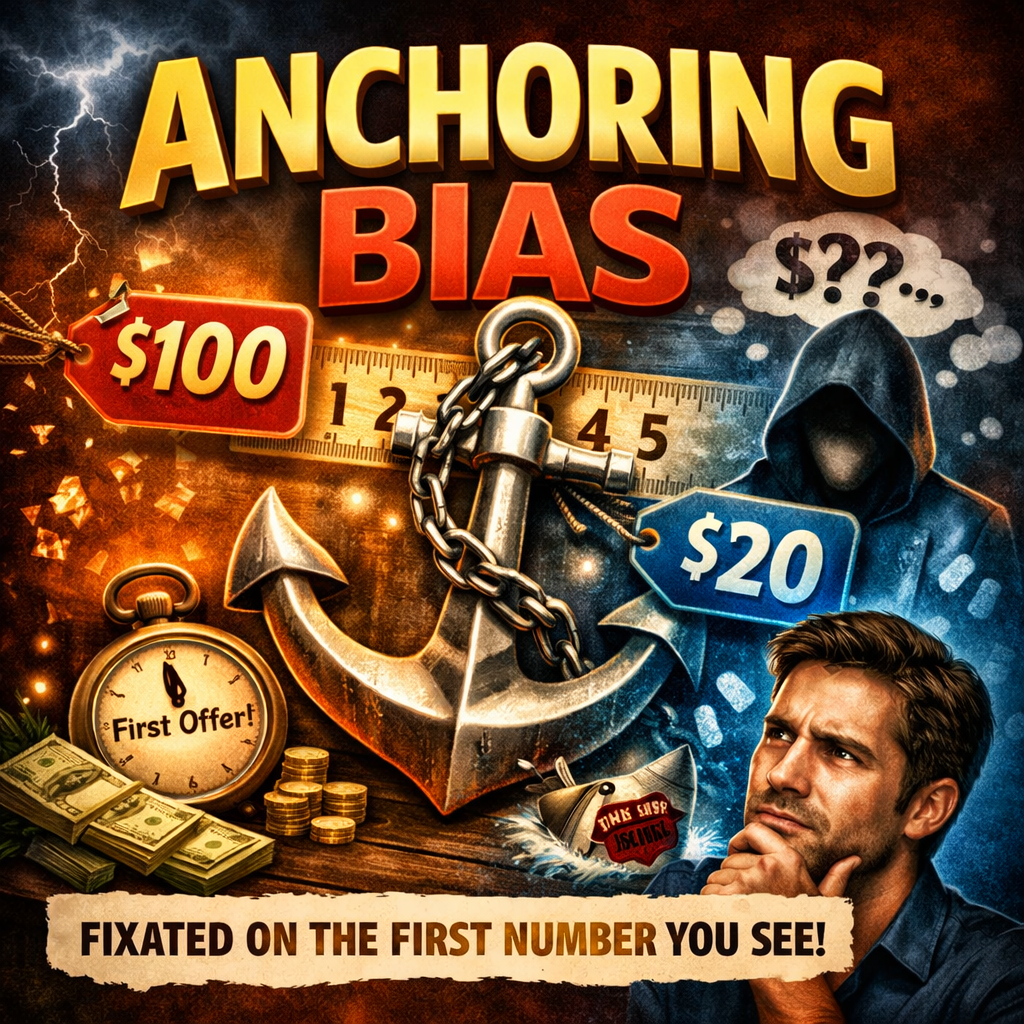
This is Anchoring Bias—a psychological phenomenon where the first piece of information we receive becomes a mental reference point for everything that follows.
Table of contents [Show]
What Is Anchoring Bias?
Anchoring Bias is our tendency to rely too heavily on the first piece of information we encounter when making decisions.
That initial information becomes an anchor.
Even when the anchor is irrelevant, our brains use it as a starting point.
As a result, our judgments become biased toward that initial reference.
Why Does Our Brain Do This?
Our brains like shortcuts.
When we face uncertainty, we naturally look for a starting point.
The first number, opinion, or piece of information we receive provides that starting point.
Instead of evaluating every option from scratch, our minds begin making adjustments from the anchor.
The problem?
Those adjustments are often too small.
We remain closer to the original anchor than logic would suggest.
Anchoring Bias Is Everywhere
Once you recognize it, you'll start seeing it in everyday life.
Shopping
A jacket is listed at $300 but marked down to $180.
Even if $180 is still expensive, it feels like a bargain because your mind compares it with the original price.
The discount becomes the anchor.
Salary Negotiations
An employer offers $70,000.
Even if the role is worth more, that first number influences the entire negotiation.
Future discussions revolve around the original offer.
Real Estate
A house is initially listed for a very high price.
Even after several price reductions, buyers continue comparing it to the original listing price.
The first number continues to shape their perception of value.
Restaurants
You open a menu.
The first steak costs $80.
Suddenly, the $45 steak feels reasonable.
The expensive item wasn't necessarily there to sell.
Sometimes, it's there to influence what feels affordable.
How Businesses Use Anchoring Bias
Businesses use anchoring in countless ways.
Retail stores display the original price next to the sale price.
Restaurants include one extremely expensive item on the menu.
Streaming services show premium subscription plans before standard ones.
Car dealerships often begin negotiations with a higher price.
The goal isn't always to sell the most expensive option.
It's to make the next option seem more attractive.
When Anchoring Helps
Anchors aren't always harmful.
They can simplify complex decisions by giving us a starting point.
When buying a house, comparing recent market prices provides a useful anchor.
When estimating project timelines, previous experience offers valuable reference points.
Anchors become helpful when they're based on reliable information.
When It Becomes a Problem
Anchoring bias becomes problematic when the anchor is irrelevant or misleading.
It can cause us to:
- Overpay for products because the "original price" seems high.
- Accept a lower salary because of the employer's first offer.
- Judge people based on first impressions.
- Make financial decisions using outdated information.
- Ignore objective evidence because we're fixated on an initial number.
The first impression becomes more influential than the facts.
How to Reduce Anchoring Bias
The next time you're making an important decision, ask yourself:
- What was the first number or opinion I encountered?
- Is that information actually relevant?
- If I had never seen that first number, what would I think now?
- What objective evidence supports my decision?
- Have I compared multiple independent sources?
These questions help loosen the anchor and encourage more balanced thinking.
Final Thoughts
Our minds crave reference points.
The first number.
The first opinion.
The first impression.
They all become anchors that quietly shape our decisions.
Sometimes those anchors guide us in the right direction.
Other times, they pull us away from reality.
The next time something feels like an incredible deal—or an obvious choice—pause for a moment.
Ask yourself:
Am I making this decision based on its true value... or simply because of the first anchor my mind grabbed onto?



Join the discussion
Sign in with your account to post comments, reply to others, and participate in the conversation.
Login to Comment